
Banking services across India, particularly at public sector banks, are set to be disrupted for three days starting Monday due to a nationwide strike by bank unions. The strike, called by the United Forum of Bank Unions (UFBU), is primarily to press for a five-day working week and other demands, despite the finance ministry's appeal for dialogue.

Bankers said the impact could become more visible from September 29 as customers could withdraw larger amounts of cash, although ATM operations are increasingly managed through third-party cash-loading arrangements.

Banking services, particularly at public sector banks across India, were impacted by a nationwide strike called by the United Forum of Bank Unions (UFBU) to demand the immediate implementation of a five-day workweek and resolution of pending wage-related issues.

The Indian government has approved the sale of a 60.72 per cent stake in IDBI Bank Ltd to Canadian billionaire Prem Watsa's Fairfax Financial Holdings Ltd for approximately 52,878 crore, a move that reflects improving India-Canada ties and marks a significant turning point for the bank.

A two-day weekend would help employees recover physically and mentally. They would return better prepared for branch work that demands patience, judgment, and accuracy, asserts Tamal Bandyopadhyay.

'There will be some inconvenience to people. But we have given one-month notice to the government one month ago.'
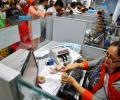
The finance ministry has announced that all banks, including Regional Rural Banks, will remain open on Sunday, September 27, 2026, to ensure public convenience amidst a proposed three-day strike by the United Forum of Bank Unions (UFBU) starting September 28, 2026. The strike, if it materialises, seeks a 5-day banking week and pension reforms.

'Resolution plan with this much haircut is totally unviable.'

China has voiced strong opposition to India's recent decision to standardise names for 28 strategic locations and geographical features in Ladakh.

Union Minister Ashwini Vaishnaw announced that the Indian government will release a draft consultation paper on Artificial Intelligence (AI) regulations within the next 30 days, focusing on safety, a human-first approach, skilling, inclusivity, and harm restriction.
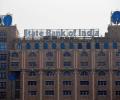
State Bank of India (SBI) anticipates that the newly introduced Merchant Discount Rate (MDR) on person-to-merchant (P2M) UPI transactions above 2,000, effective October 15, will enable it to recover the costs incurred in processing and facilitating these transactions, potentially even generating a small surplus.

The Enforcement Directorate has made its sixth arrest, Mukesh Kumar Pukhraj Jain, in a pan-India cyber fraud and digital arrest case involving transactions worth Rs 30,000 crore. Jain is accused of acting as an RTGS agent for the criminal network. The probe, initiated by a Goa Police FIR, uncovered a vast money laundering operation across 20 states, with funds converted into foreign currency and linked to numerous shell companies.

Finance Minister Nirmala Sitharaman stated that the Reserve Bank of India (RBI) will persist in its efforts to prevent excessive volatility in the rupee, which has significantly depreciated against the US dollar due to global uncertainties, despite India's strong macro-economic fundamentals.

The rise in loan sizes reflects both higher vehicle prices and a shift from entry-level cars to SUVs.

IT Minister Ashwini Vaishnaw announced that the Indian government will release a consultation paper on AI regulations within a month. This framework will address critical aspects like AI safety, deepfakes, and a human-first approach, emphasising the industry's primary responsibility in ensuring safe AI deployment. The move comes amidst growing global concerns over AI risks and the need for robust safeguards.

Union Finance Minister Nirmala Sitharaman expressed strong confidence in India achieving over 10 per cent economic growth, advocating for increased technology adoption and innovation. She urged overcoming scepticism and highlighted technology's transformative role in agriculture and public sector reforms, while also launching a new fund and book at an IIT Madras event.

Industry experts advocate for India to develop its own artificial intelligence (AI) safety framework, distinct from US or EU models, to address unique challenges like deepfakes and cyberattacks. They call for a comprehensive commitment involving all stakeholders and a hybrid regulatory approach combining voluntary and binding measures, as the Indian government also considers new AI regulations.

'It's not about individuals operating the mule accounts being more or less skilled. Instead, 'lower-level' refers to the role the individual account plays in the broader mule network.'

Union Finance Minister Nirmala Sitharaman announced the government's plan to establish a high-powered committee to examine reforms for the banking sector, aligning it with the vision of a 'Viksit Bharat' (Developed India) and India's next phase of growth.

The United Arab Emirates (UAE) has expressed intent to invest an additional $25 billion in India, with an ultimate goal of reaching $100 billion in investments, Union Minister Piyush Goyal announced. This comes as both nations plan to enhance cooperation in shipping, ports, energy, and emerging technologies, against a backdrop of expanding bilateral trade.

Nandan Nilekani, head of the task force on exam reforms, stated on Tuesday that technology and a systematic approach can solve the issue of question paper leaks. He suggested generating exam papers from a large question bank at the last minute to remove economic incentives for leaks and also proposed moving towards computer-based testing.
The Rajya Sabha has passed The Bankers' Books Evidence Bill, 2026, which aims to replace a British-era law and allow digital and virtual records to be admissible as evidence in courts. This legislation aligns with contemporary digital banking practices and extends a uniform evidential framework to various financial entities, including NBFCs and fintech companies. Finance Minister Nirmala Sitharaman highlighted the bill's role in strengthening public confidence and safeguarding customer privacy. The bill's passage, however, saw an Opposition walkout over unrelated issues.

The CBI has filed a closure report in the 2002 disinvestment of Hindustan Zinc Ltd, stating that allegations of irregularities could not be substantiated. This comes despite a 2022 Supreme Court directive by then-CJI D Y Chandrachud to register a regular case, citing sufficient material and concerns over undervaluation and the role of a global advisor. The special court will now decide on the report.

Jio Platforms (JPL) is preparing a capex-light strategy to commercially launch 6G services in the early 2030s through software upgrades, rather than fresh infrastructure investments, according to Akash Ambani, managing director of JPL.

India's UPI International payment system is now playing a crucial role in humanitarian efforts, enabling seamless disaster relief donations from Indian users to Nepal's Prime Minister Disaster Relief Fund, showcasing its growing global acceptance and utility beyond tourism. UPI IMAGE: Kindly note that this image has been posted for representational purposes only. Photograph: Unsplash Key Points UPI International, initially for Indian tourists, is now facilitating disaster relief donations to Nepal's Prime Minister Disaster Relief Fund. The embassy of Nepal in India is actively encouraging Indian users to utilise their UPI apps for these contributions. This marks a significant shift, expanding UPI's cross-border use case beyond tourism to include inbound collection for foreign governments. The move positions UPI International alongside global payment giants like Alipay+ and UnionPay for international aid. Donors need to activate the UPI International feature on their apps to transact, with amounts converted from INR to NPR.

India is making a significant push to establish itself as a global semiconductor manufacturing hub, driven by strategic investments and policy support. The upcoming SEMICON India 2026 event will showcase the country's advancements and ambitions in this critical industry, which underpins virtually all modern electronic devices and has faced global supply chain vulnerabilities.

Union Communications Minister Jyotiraditya Scindia announced India's ambition to lead the world in 6G mobile technology and become a designer of global technology standards. Speaking at the Global Fintech Fest 2026, Scindia highlighted India's shift from being a technology market to a technology maker, emphasizing progress in 5G rollout, affordable data, and digital infrastructure driving fintech growth, while also stressing the importance of digital security.

The asymmetry in deposit and credit growth is the biggest challenge before the Indian banking industry. For every 100 deposit that a bank mobilises, it needs to keep 3 with the banking regulator in the form of cash reserve ratio on which it doesn't earn any interest. Another 18 is used for buying government bonds (statutory liquidity ratio). This means, a bank is left with 79 for giving credit. Add to this, its capital which can be used for giving loans. Most banks are facing a fund crunch. They need to find ways to attract deposits if they want to sustain credit growth, explains Tamal Bandyopadhyay.

75% of India's 60 million digital-payment merchants have never recorded a transaction above 2,000.

India and China are in what experts call 'a cooperation-versus-competition situation'.

Delhi Police have taken stringent measures to prevent the Cockroach Janta Party's 'Lehra Do Tiranga' march in Connaught Place, deploying thousands of personnel and citing prohibitory orders under Section 163 of the BNSS due to risks of traffic disruption, stampede, and threats to public safety.

Moody's Ratings has sharply increased India's GDP growth forecast for fiscal 2026-27 to 7 per cent, making it the fastest among G20 economies, driven by economic resilience despite the Middle East conflict. However, the agency flagged significant inflation risks stemming from elevated oil prices and potential El Nino disruptions.
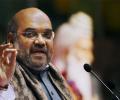
Union Home Minister Amit Shah lauded UPI on its 10th anniversary, highlighting its role in India's digital transformation. Launched by NPCI in 2016, UPI has become the world's largest real-time payment system, witnessing a massive surge in transaction volume and value, demonstrating its success in empowering people with swift, seamless, and secure digital transactions.

As the world's most populous country, India's economy looks large in the aggregate even as its average incomes stay modest.

Kunwar Basit Ali, national president of BJP Minority Morcha, stated that the demolition of religious structures for development should not be viewed communally, citing examples from Uttar Pradesh and Muslim nations. He accused the Congress of misleading Muslims and instigating unrest. Ali also expressed confidence in the BJP forming the next government in Jammu and Kashmir and addressed concerns regarding the delay in statehood restoration, asserting that the central government would make the best decisions for Kashmir.

Life Insurance Corporation of India (LIC) is facing a thinning of its top management as Managing Director Dinesh Pant exits to join Irdai, leaving one of four MD posts vacant. This comes amidst broader staffing challenges across several public sector insurers and a headless Financial Services Institutions Bureau (FSIB).
The World Bank has increased India's economic growth projection for FY27 to 6.6 per cent, citing resilient domestic demand, while simultaneously cutting its global economic growth outlook due to the conflict in West Asia.

The CBI has registered a case against USA-based Christian missionary group The Timothy Initiative (TTI) and its associates for allegedly misusing Rs 92.55 crore in foreign funds for missionary activities, violating the Foreign Contribution (Regulation) Act, 2010. The case, based on a Union Home Ministry complaint and ED investigation, highlights the alleged use of foreign debit cards and attempts to conceal identities.

India has removed a key regulatory hurdle, allowing exporters to receive payments in Indian currency while retaining incentives under the country's foreign trade policy, a move aimed at promoting wider use of the rupee in international trade.

The article details a history of internal disagreements among Election Commissioners in India, highlighting instances from 1993 to the present, including clashes between CECs and commissioners over various issues like removal recommendations, dissent notes, and affidavits, culminating in recent objections regarding voter list revisions.
